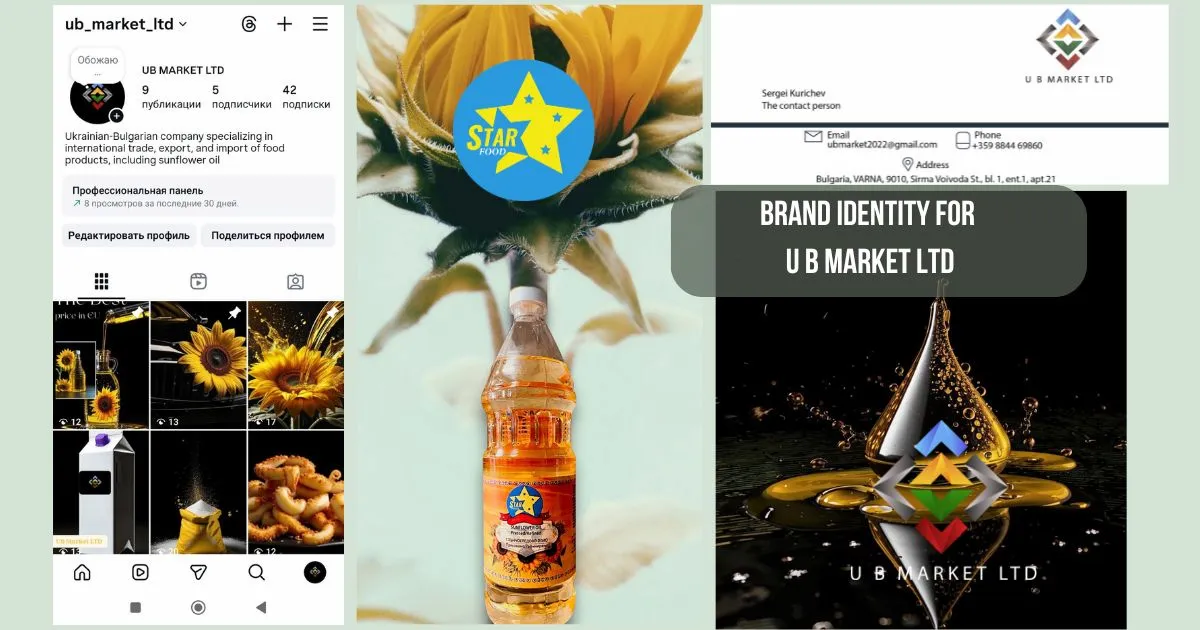
How do you build a complete brand identity for a European food company? UB Market case study
Some projects arrive as a single line and quietly grow into something much bigger. UB Market started with "we need a logo." Three months later it was a corporate identity, a registered consumer trademark, EU-compliant product packaging in six languages, and a B2B website concept — for a food trade company exporting to 12+ countries across Europe.
This case study walks through every stage: the decisions, the problems, and one moment where a design I actually liked had to go for legal reasons.
One thing worth saying upfront: when a client mentions "we also need a trademark for a product line" halfway through a logo project, the scope has changed completely. With UB Market we caught it early enough. Not every project is that lucky.
Quick Answer: what does a complete food brand identity cost in 2026?
- 💰 Corporate logo only: €150–€400 · 5–7 working days
- 💰 Logo + trademark (second brand): €300–€700 · 10–14 working days
- 💰 EU-compliant product label: €150–€280 per label · 5–7 working days
- 💰 Full brand system (logo + trademark + label + guidelines): €800–€1,500 · 3–5 weeks
- 💰 Website design concept: €500–€1,200 · 7–14 working days
Who is UB Market and what did they actually need?
UB MARKET LTD is a food trade company based in Varna, Bulgaria, specialising in international wholesale — sunflower oil, sugar, dairy, and more — to over 12 European countries. Their buyers are wholesale distributors, retail chains, and food service operators in Germany, Poland, Greece, Czech Republic, Slovakia, and beyond.
The initial brief was a corporate logo. During the first call, a second need came up: a separate consumer-facing trademark called Star Food, for mass-market packaged food products. Two brands, two visual systems, one project.
This is a common structure in European food trade. A B2B corporate entity (UB Market LTD) and a B2C consumer brand (Star Food) running in parallel. The corporate identity needs to look credible to wholesale buyers. The consumer brand needs to stand out on a supermarket shelf. These are different design problems — treating them as the same brief is how you end up with something that works for neither.
How do you design a corporate logo for a food trade company?
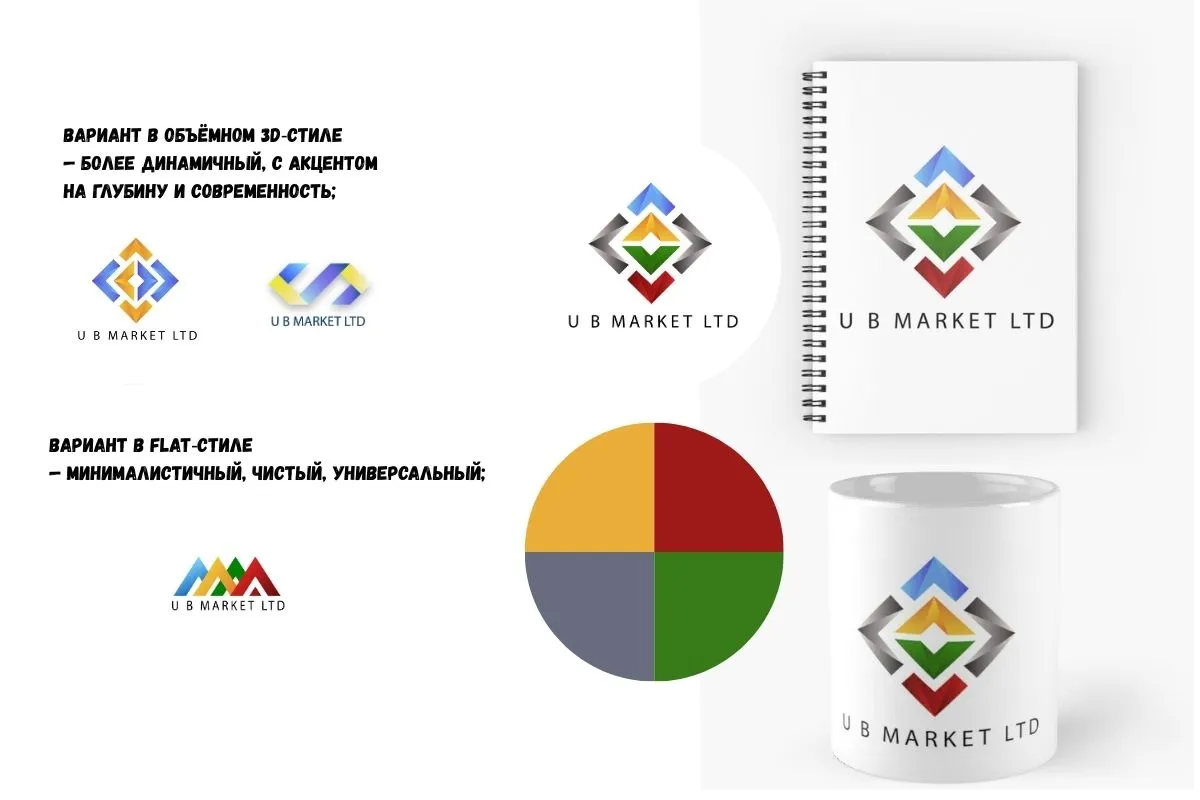
The UB Market logo had one job above everything else: international credibility. A company exporting food to 12 European countries needs a visual identity that doesn't read as regional. It needs to feel equally at home on a customs document, a trade fair stand in Cologne, or a partner portal in Warsaw.
Three directions were developed: a flat minimalist version — clean and universally readable, a volumetric 3D-style version — more dynamic with a premium feel, and additional compositional variations. Each was tested against real use cases: letterhead, truck livery, customs documentation, trade portal listings. Not just how it looks in a mockup.
What happened at the end surprised us both. After a full month of revisions — testing directions, comparing options, running candidates past the client's distribution partners — the decision was to keep the very first version. The original was the most harmonious, the most balanced, the most honest to the company's character.
I see this regularly. Sometimes the first intuition is the strongest. But you can't defend a first draft without having tested it against alternatives. The client needs to know they chose the best option, not just the one that came first.
| What we tested | Why we moved on |
|---|---|
| Flat minimal version | Selected — credible, universal, scalable |
| Volumetric 3D style | Dated on screen, problematic at small sizes |
| Ribbon/accent variants | Too decorative for B2B context |
| Geometric symbol variants | Too abstract for food trade category |
| Best for: | B2B food wholesale, export-oriented companies |

What makes designing a trademark different from designing a logo?
A logo identifies a company. A trademark is a legal instrument — it has to be registrable, defensible, and precisely describable in legal documentation.
Star Food needed to work as a universal consumer brand across multiple product categories. Early concepts included a red ribbon element — good visual contrast, dynamic, strong food association. It tested well in mockups. I liked it.
Then the legal description requirement arrived.
During trademark registration preparation, a significant problem emerged: the ribbon required an overly detailed and complex legal description. In trademark law, every visual element must be described precisely in words. Complex elements create longer, more ambiguous descriptions — which create vulnerabilities during registration and enforcement across multiple EU jurisdictions.
The decision was made to go with a cleaner, more concise mark. Simpler to describe, easier to register, stronger as a foundation for future product lines.
This is the kind of decision that never appears in a design portfolio but determines whether the work actually succeeded. A logo that can't be registered is a logo that failed its brief.
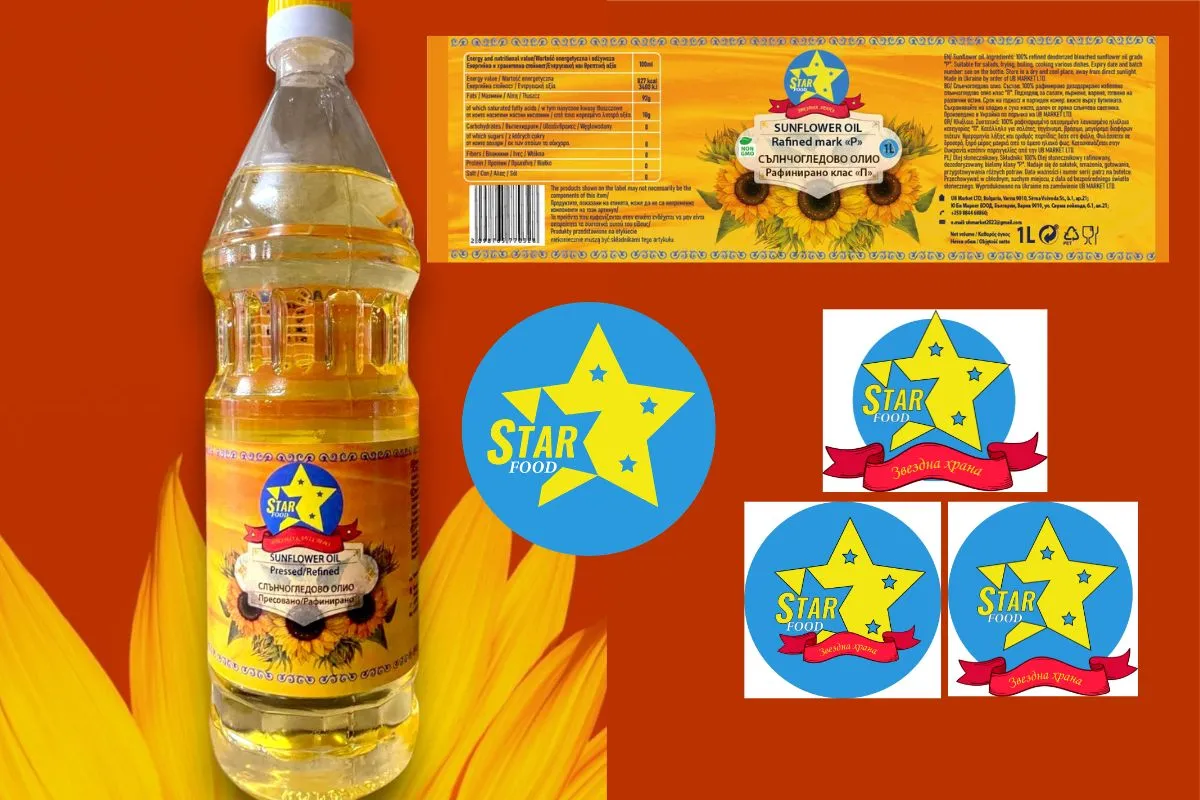
The final version — no ribbon, no extra elements. Cleaner, legally defensible, and as it turned out, visually stronger than the variants with additional details.
How do you design an EU-compliant food product label?
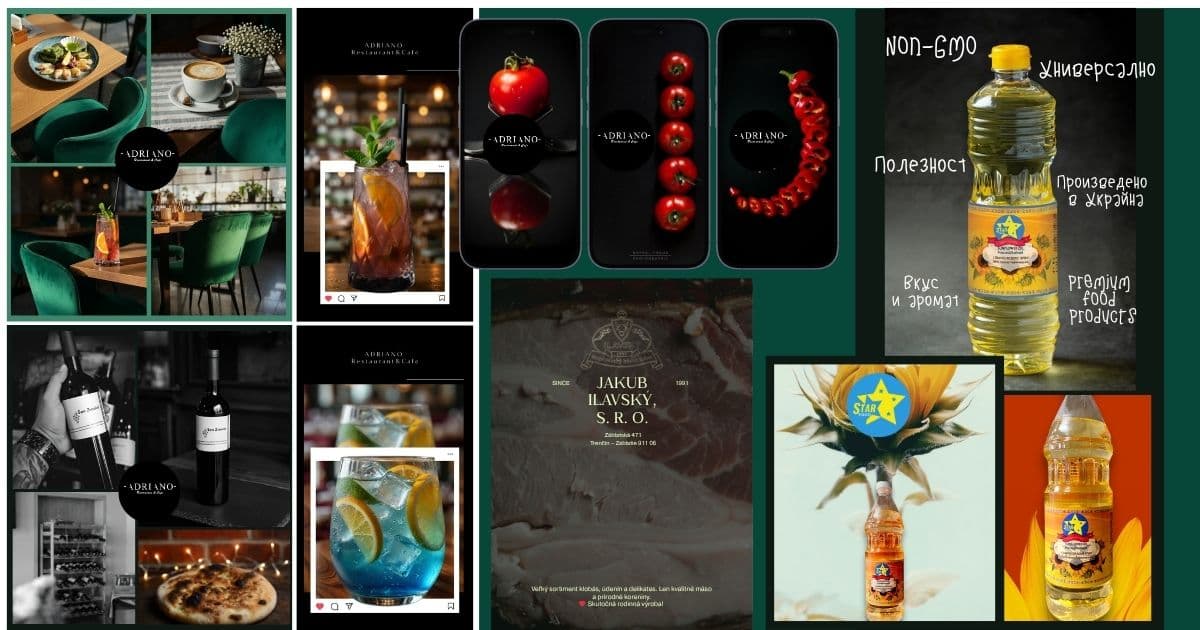
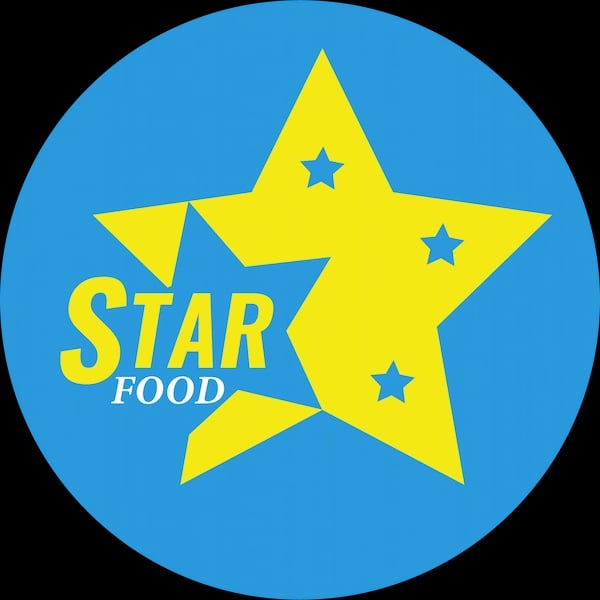
The Star Food logo went first onto sunflower oil — the company's flagship product. This is where the design work became genuinely technical.
An EU-compliant food product label is not a creative brief. It's a regulatory checklist with creative execution layered on top. The label had to meet EU Regulation 1169/2011 — mandatory nutritional information in a specific format, minimum font sizes, exact positioning for certain declarations. Non-GMO certification. Net weight, country of origin, allergens — all mandatory, all with placement rules.
And the language requirement: the same label carries Bulgarian, English, German, Polish, Greek, and Czech text simultaneously. Without becoming illegible.
The minimalist approach to the Star Food logo wasn't just aesthetic — it was the right choice for this label. A complex mark would compete with the mandatory text. A clean mark gives the regulatory information the space it needs while keeping the packaging visually coherent.
The label was adapted for both 1L and 5L container formats. The 5L label has more space — the brand can breathe. The 1L label is a compression exercise: everything mandatory, nothing else.
What does a B2B food company website need to communicate?
The website concept for ub-market.com was the fourth element. By this point the visual language was established — colour palette, typography, the relationship between the two brand marks. The website extended that system into a digital B2B context.
Professional B2B structure with clear product categories, certifications, logistics workflow, and partner contact paths. Multilingual interface for buyers from Greece, Poland, Germany, Czech Republic, Slovakia. Six product categories with technical specifications relevant to wholesale buyers: sunflower oil, frying oil, sugar, high-oleic oil, dairy products, mayonnaise.
The continuity from packaging to website matters more than it might seem. A wholesale buyer who encounters UB Market at a trade fair, picks up a Star Food product in a supermarket, and then visits the website should have a consistent experience — even if they don't consciously notice it. That consistency is what builds trust in B2B relationships.
What were the results?
| Corporate logo | UB MARKET LTD — flat minimalist, EU-credible |
| Consumer trademark | Star Food — registration-ready, simplified for legal description |
| Product label | EU Regulation 1169/2011, 6 languages, Non-GMO certified |
| Website concept | B2B platform, 6 product categories, multilingual |
| Total scope | 5 deliverables, 3 weeks |
The Star Food brand is now on sunflower oil (1L, 5L), frying oil, high-oleic oil, and mayonnaise — distributed across 12+ European countries.
What makes this project useful as a case study isn't the design itself — it's the sequence. Logo → trademark → label → website is a chain where each element constrains the next. The trademark simplification decision affected the label. The label affected the website visual hierarchy. A change at any stage would have required changes downstream.
That's why brand identity projects benefit from being designed as a system. When each piece is commissioned separately, inconsistencies accumulate. After two years you have a company that looks like three different businesses depending on where someone encounters you.
Read also: logo design pricing in 2026 → and how we built the Adriano brandbook →
Planning a brand identity for your food or export company?
FormaInk creates complete visual identities for food companies, export businesses, and product brands across Slovakia, Austria, Czech Republic, and Central Europe — including EU-compliant label design, trademark preparation, and multilingual packaging.
Every project starts with a free consultation — we respond within 24 hours.

Need a brand identity for your business?
FormaInk creates logos, brandbooks and visual identities for businesses in Slovakia, Austria and Central Europe.
Get in touch